Governor backs bill demanding students give teachers
respect
By ANGELA ROZAS
LSU student writer
|
Advocate staff photo by Travis Spradling
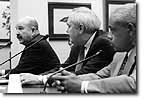
Mike Foster, left, urged a committee to pass a proposed law demanding
respect in schools so that "If a student came in every day and gave the
teacher ‘the bird,’ something would happen to them. |
Gov. Mike Foster said Thursday he wants to require public school
students to give more respect to their teachers, and Senate Education Committee
members said "Yes, sir."
A proposed law requiring public school students to stand when teachers
or administrators enter a room, and to address teachers and administrators
with "respectful terms" was approved by the Senate Education Committee.
SB1098, by Sen. "Don" Cravins, D-Lafayette, prompted a personal appearance
by the governor, who stressed to the committee that demanding respect from
students would result in better discipline.
"What we hear over and over again, as our biggest problem in schools
is discipline," Foster said.
"If we can demand respect, we can get discipline," he said.
If the bill becomes law, beginning this fall students would be required
to "stand and shall remain standing until the appropriate school official
instructs the student or students to be seated."
Students would also be required to "address and respond to such teacher
or administrator by using the respectful terms ‘Yes, Ma’am’ and ‘No, Ma’am’
or ‘Yes, Sir’ and ‘No, Sir’, as appropriate, or ‘Yes, Miss, Mrs., or Ms.
(Surname)’ and ‘No, Miss, Mrs., or Ms. (Surname)’ or ‘Yes, Mr. (Surname)’
and ‘No, Mr. (Surname)’, as appropriate," according to the bill.
When Sen. Lynn Dean, R-Chalmette, questioned Foster on how the bill
would be enforced, Foster responded that the city and parish school systems
would take on that responsibility, just like enforcement of other rules
of conduct.
"If a student came in every day and gave the teacher ‘the bird,’ something
would happen to them," said Foster.
"I don’t think you would have to expel anybody for the first offense,
but there are other things we require people to do if they break the rules,"
he said.
Cravins told the committee that no matter how much money was invested
into public education, the schools still needed better discipline to improve.
"I in no way believe this will resolve all the problems in our schools,"
said Cravins. "But it is the first step in addressing some of the problems
in this community." |


